

Building a brand online without a solid SEO strategy is like opening a store and never putting up a sign. You might have a great product or service, but if people cannot find you on search engines, you are losing potential customers every day. Search engine optimization is not a one-time task you check off after launching a website. It is an ongoing process that shapes how your brand is discovered, perceived, and trusted online.
SEO is also much broader than just publishing content. At its core, a strong SEO strategy is about making your website relevant, authoritative, and easy for both search engines and real users to understand. It directly impacts your lead generation, brand visibility, and long-term growth. Whether you are just starting out or looking to improve existing rankings, understanding the four core elements below gives you a clear foundation to build on.
On-Page SEO vs. Off-Page SEO: A Quick Distinction
Before diving into the elements, it helps to understand that SEO is typically divided into two major categories: on-page SEO and off-page SEO. On-page SEO covers everything you control directly on your website, including content, keywords, page structure, and meta tags. Off-page SEO refers to actions taken outside your website that influence your rankings, such as backlinks and social media signals.
The four core elements discussed in this blog apply across both categories. A well-rounded SEO strategy addresses all of them together rather than treating them as separate checklists.
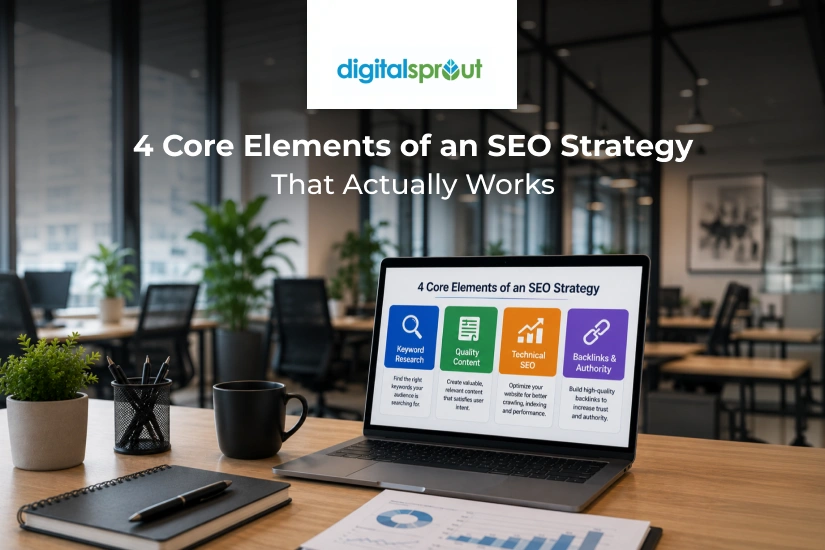
4 Core Elements of an Effective SEO Strategy
1. Content and Keywords
Content is the foundation of every SEO strategy. It is not just the text on your pages; content includes images, videos, headings, and any element that communicates with your visitors and signals relevance to search engines. The phrase “content is king” exists for a reason. Well-optimized content builds brand authority, drives organic traffic, and supports lead generation over the long term.
Keywords are inseparable from content. They are the specific words and phrases your potential customers type into search engines when looking for what you offer. Choosing the right keywords tells Google what your brand is about and helps match your pages to the right searches. For example, if you want to rank for “digital marketing company Maryland,” your content needs to clearly and naturally reflect that focus throughout the page.
A few content and keyword best practices worth following:
- Research keywords based on search volume, competition, and relevance to your business.
- Use keywords naturally in headings, body copy, image alt text, and URLs.
- Prioritize content that genuinely answers what your audience is searching for, not just content that checks keyword boxes.
- Update existing content regularly so it stays accurate and competitive.
Investing in professional SEO services ensures your keyword research is built on real data, not guesswork.
2. Backlinks
Backlinks are links from other websites that point to yours. They are one of the most significant ranking factors in SEO because Google treats them as votes of confidence. When a reputable website links to your content, it signals to search engines that your page is trustworthy and worth ranking.
That said, not all backlinks are equal. Low-quality or irrelevant links can actually hurt your rankings. The goal is to earn links from websites that are relevant to your industry and genuinely respected online. Here are two reliable ways to build a strong backlink profile:
- Create content worth linking to. Useful guides, original data, in-depth resources, and expert commentary tend to attract organic links from other sites and influencers in your space.
- Publish guest posts on reputable websites in your niche. This earns you quality backlinks while also expanding your brand reach to new audiences.
Building backlinks takes time and consistency, but it remains one of the most effective long-term investments in your SEO strategy.
For businesses without an in-house team, partnering with an SEO company for small business owners is often the most efficient way to build this kind of link profile consistently.
3. Social Media
Social media plays a meaningful role in any modern SEO strategy. While social signals are not a direct Google ranking factor, the relationship between social media activity and search performance is well established. Strong social media presence drives traffic to your website, increases content visibility, and builds the kind of brand awareness that leads to more branded searches over time.
Active social profiles also help search engines verify that your brand is legitimate and authoritative. Profiles on platforms like Facebook, Instagram, LinkedIn, and X that are consistently maintained and linked back to your website send positive signals about your brand’s credibility.
Beyond that, social media amplifies your content. When a blog post or page gets shared widely, it increases the chances of earning organic backlinks, which directly benefits your rankings. Think of social media as a distribution channel that extends the reach of everything else in your SEO strategy.
4. Meta Tags
Meta tags are HTML elements that provide information about your web pages to search engines and users. The two most important for SEO strategy are the meta title and the meta description. While meta descriptions are not a direct ranking factor, both play a significant role in whether users click on your result in the search engine results page (SERP).
Your meta title is what appears as the clickable headline in Google search results. It should clearly include your target keyword and accurately describe what the page is about. Your meta description is the short summary below the title. A well-written meta description can significantly improve your click-through rate, which over time does influence how Google ranks your page.
Here is what to keep in mind when writing meta tags:
- Meta titles should ideally be between 50 and 60 characters to avoid being cut off in search results.
- Meta descriptions work best between 150 and 160 characters.
- Include your primary keyword naturally in both the title and description.
- Write for the user first. The goal is to earn the click, not just satisfy the algorithm.
Putting It All Together
No single element of an SEO strategy works in isolation. Content and keywords give your pages relevance. Backlinks give them authority. Social media extends their reach. Meta tags make them clickable. When these four elements work together as part of a consistent, well-planned approach, the results compound over time.
For businesses that are just getting started or struggling to gain traction in search rankings, working with an experienced SEO company can make a significant difference. The right partner brings both technical expertise and strategic direction, so you are not wasting time on tactics that do not move the needle.
How Digital Sprout Delivers Results-Driven SEO Services in Maryland
At Digital Sprout, we are a trusted SEO company for small business owners and mid-sized brands across Maryland, Virginia, Florida, and beyond. Our SEO services in Maryland are fully customized, from technical site audits and keyword research to content strategy, link building, and ongoing performance tracking.
We do not believe in cookie-cutter plans. Every campaign is built around your specific goals, competitive landscape, and budget. Whether you need to rank higher in local search, drive more qualified traffic, or build long-term organic authority, our team develops and executes the strategy from start to finish.
From search engine optimization and paid ads to website design and social media, we offer a complete digital marketing solution designed to turn your online presence into a consistent source of growth. Ready to get started? Contact Digital Sprout today and let’s talk about getting your business to page one.
Here are 6 FAQs optimized for AI Overviews, People Also Ask, and featured snippets:
Frequently Asked Questions
Q1. What are the core elements of an SEO strategy?
The four core elements of an effective SEO strategy are content and keywords, backlinks, social media, and meta tags. Content and keywords establish your relevance for search queries. Backlinks build your domain authority by earning links from trusted external websites. Social media extends your content’s reach and drives referral traffic. Meta tags, including your meta title and meta description, tell search engines what your page is about and influence how users interact with your result in the search engine results page.
Q2. How long does it take for an SEO strategy to show results?
Most businesses begin to see measurable improvements from an SEO strategy within three to six months, though this varies depending on the competitiveness of your industry, the current state of your website, and the consistency of your efforts. Technical fixes and on-page optimizations can show results faster, while building domain authority through backlinks and content typically takes longer. SEO is a long-term investment, and results tend to compound significantly over time.
Q3. What is the difference between on-page and off-page SEO?
On-page SEO refers to all the optimizations made directly on your website, including content quality, keyword placement, page speed, internal linking, and meta tags. Off-page SEO covers actions taken outside your website that influence your rankings, most notably backlinks from other websites and social media signals. A strong SEO strategy addresses both, since on-page work establishes relevance while off-page efforts build authority.
Q4. Why are backlinks important for SEO?
Backlinks are important for SEO because search engines treat them as votes of confidence from other websites. When a reputable, relevant website links to your page, it signals to Google that your content is trustworthy and worth ranking. The quality of backlinks matters far more than quantity. A handful of links from authoritative websites in your industry will have a greater positive impact on your rankings than hundreds of links from low-quality or unrelated sources.
Q5. How do meta tags affect search engine rankings?
Meta tags, specifically your meta title and meta description, help search engines understand what your page is about and match it to relevant search queries. The meta title is a confirmed ranking factor and should include your primary keyword naturally. While the meta description is not a direct ranking factor, a well-written description improves your click-through rate in search results, which over time sends positive engagement signals to Google and can indirectly support better rankings.
Q6. Do small businesses need a professional SEO company?
Small businesses can benefit significantly from working with a professional SEO company, particularly if they lack in-house expertise or time to manage SEO consistently. Search engine optimization involves ongoing technical maintenance, content development, keyword research, and link building, all of which require both skill and sustained effort. A dedicated SEO company for small business owners brings the tools, experience, and strategic direction needed to compete effectively in local and organic search without diverting focus from running the business.