

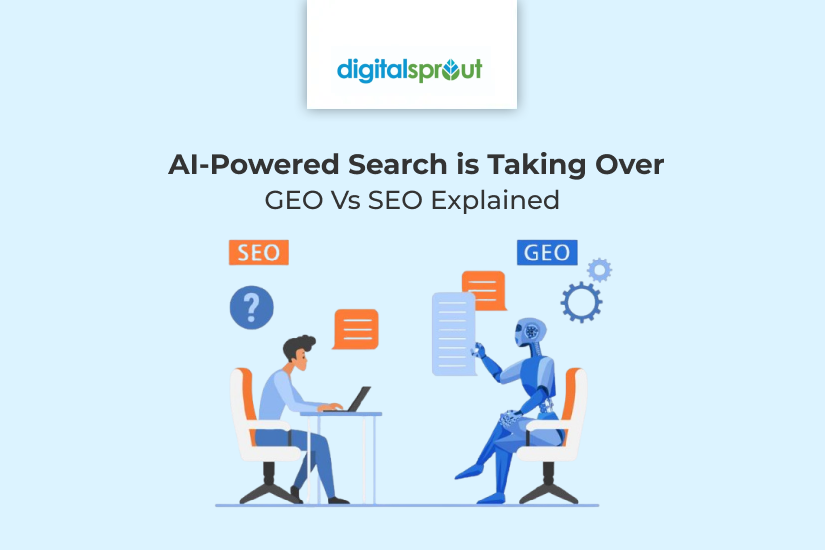
This guide breaks down the differences, practical applications, and future directions of both strategies, and how AI in digital marketing is leading the charge.
What Exactly Are GEO and SEO?
SEO Explained Simply
Search Engine Optimization is about making your site more visible on search engines like Google and Bing. It means adjusting on-page content, site speed, technical performance, and link authority. With effective SEO services, brands climb search results, pulling in steady, long-term traffic.
GEO in Action
Generative Engine Optimization is newer. Instead of focusing only on search results pages, GEO adapts content for AI-driven platforms like Google AI Overviews, ChatGPT search integrations, or Microsoft Copilot. In these spaces, users don’t always click through; they get direct answers. So GEO is about becoming part of the AI’s response.
Why Both GEO and SEO Still Matter
SEO is not disappearing. In fact, it is foundational. GEO builds on it. Without clean, reliable, and structured data, AI engines have nothing solid to work with. Businesses that neglect SEO risk losing ground, but ignoring GEO means missing opportunities where AI is already curating answers. Smart brands aim for a hybrid, ensuring content performs in both environments.
How AI in Digital Marketing Drives the Transformation
Mass Adoption and Market Growth
The global market for AI-driven marketing tools hit $47.3 billion in 2025, up from $12 billion in 2020. Growth projections expect it to triple by 2028. Such growth shows how embedded AI in digital marketing has become.
What Teams Are Doing Differently
A recent survey shows 88 % of marketers now use AI daily. Tasks include keyword research, content optimization, predictive analytics, and campaign testing. It’s not about replacement, it’s about extending what marketers can do.
Decision-Making Backed by Data
Sixty-five percent of executives confirm that predictive AI tools help them identify market shifts faster. This supports why AI in digital marketing is being treated as a strategic core, not just a side tool.
Practical Steps for Businesses
1. Strengthen Core SEO First
SEO is still the backbone. Brands should make sure site speed is optimized, broken links are fixed, and metadata is clear. Reliable SEO services act like a foundation; without them, GEO has no base.
2. Prepare for AI-Driven Search
Add FAQ sections to pages. Use schema markup. Create content that answers specific questions. The more straightforward and contextually rich the copy, the better the chances of being pulled into AI outputs.
3. Use Data to Refine Content
AI thrives on structured inputs. An audit of top-performing pages can reveal which ones need extra clarity to stand out in generative answers.
4. Focus on Authority and Trust
Citations from trusted sites and transparent sourcing will make AI systems more likely to use a brand’s content. This is where Digital Marketing Services play a crucial role in building credibility across channels.
Real-World Examples of GEO and SEO in Action
- Retail Brands are leveraging GEO to appear in AI shopping assistants, enabling instant answers to product queries.
- Healthcare companies utilize SEO to create compliance-friendly web content, while GEO helps their trusted information appear in generative health queries.
- Travel Platforms optimize with both SEO to drive organic visits and GEO to appear in AI summaries about destinations.
In all these cases, AI in digital marketing shapes not just visibility, but how customers interact with the brand.
Challenges Along the Way
Bias and Misinterpretation
AI engines sometimes surface biased or incomplete answers. Studies published in 2025 on arXiv reveal inaccuracies in AI responses across healthcare and finance sectors. Businesses need to check how they are being represented.
Overreliance on Automation
Marketers risk over-automating campaigns. AI is powerful, but without human oversight, campaigns lose empathy. This is why many leaders stress balance; AI should assist, not dominate.
The Future Outlook
- Voice and Visual Search Rise: With devices like smart speakers and AR glasses, both SEO and GEO will expand into new interfaces.
- Personalization Scales Up: AI in digital marketing will use individual behavior patterns to deliver hyper-tailored responses.
- Hybrid Optimization Becomes Normal: By 2027, expect GEO to be a default service offered alongside SEO, not an experimental one.
Final Thoughts
The digital search landscape is splitting into two lanes. SEO delivers traffic through rankings. GEO delivers citations through AI-driven engines. Both are essential. Businesses that adapt will win attention in both traditional searches and generative experiences.
Investing in Digital Marketing Services that balance these approaches is the smartest move forward. AI in digital marketing is already reshaping campaigns, customer journeys, and growth strategies. The future belongs to those who learn to blend human creativity with machine intelligence, without losing sight of trust and authenticity.
Accelerate Growth with Digital Sprout’s Digital Marketing Services

At Digital Sprout, we help businesses harness the power of AI in digital marketing and SEO to stay competitive in today’s fast-paced market. Our strategies blend innovation with proven techniques, ensuring your brand stands out where it matters most.
With offices in Annapolis and St. Petersburg, we proudly serve clients across Maryland, Florida, and nationwide. Our full suite of SEO Services is designed to drive visibility, boost organic traffic, and connect you with customers ready to act.
From social media marketing to paid campaigns, our tailored Digital Marketing Services give your business the edge it needs.
Ready to take your growth to the next level? Contact us today and let’s get started.
Frequently Asked Questions
Q: What exactly is “AI in digital marketing SEO” and how does it work?
A: AI in digital marketing” applies artificial intelligence tools, like machine learning and predictive analytics, to traditional SEO tasks. These tools help analyze search intent, surface high-value keywords, and streamline content creation that resonates with both humans and AI systems. The goal is smarter, faster optimization backed by data-driven insights.
Q: Can AI-generated search replace traditional SEO services?
A: No. AI-driven search channels complement but do not replace standard SEO services. They lay the groundwork for technical optimization, site health, and backlinks. AI-powered search (or GEO) builds on that by structuring content to be ingestible by AI systems, generating direct answers. The two are complementary, not mutually exclusive.
Q: How do I get started with AI-powered digital marketing?
A: Start small. Focus on one area, such as email optimization or chatbot automation, and gradually expand your efforts. Define clear goals, utilize AI tools to analyze customer data or tailor messaging, and then iterate based on the results.
Q: What are the risks or challenges of using AI in marketing?
A: Common concerns include misalignment with brand voice, cultural insensitivity, over-automation, and losing human empathy. To avoid this, set strong brand guidelines, review AI outputs regularly, and ensure human oversight remains central.
Q: What’s the difference between AI-powered tools and plain marketing automation?
A: Marketing automation handles repetitive tasks, like email sequences and campaign reports, based on rules. AI-powered tools go further: they learn from data, predict trends, personalize messaging, and adapt in real time.
Q: What ethical concerns should businesses watch for when using AI in marketing?
A: Key issues include data privacy, algorithmic bias, transparency, and overclaiming AI capabilities (known as “AI washing”). Businesses should maintain transparency, conduct audits for fairness, protect user data, and refrain from overstating their AI use.